Volcanoes National Park, Rwanda: The Complete 2026 Guide
Rwanda's slice of the Virunga massif is small, ringed by farmland, and holds the most tightly rationed wildlife experience on earth.
 By Eric Habimana, gorilla trekking guide since 2015
Short answer
Volcanoes National Park covers roughly 16,000 hectares in Musanze District, about 90 minutes by road from Kigali. Trekking happens between 2,500 and 4,000 metres. Twelve habituated gorilla families take eight visitors each, so 96 permits are sold per day at $1,500 for foreign non-residents. Golden monkey permits cost $100. Every activity briefs at Kinigi park headquarters at 07:00.
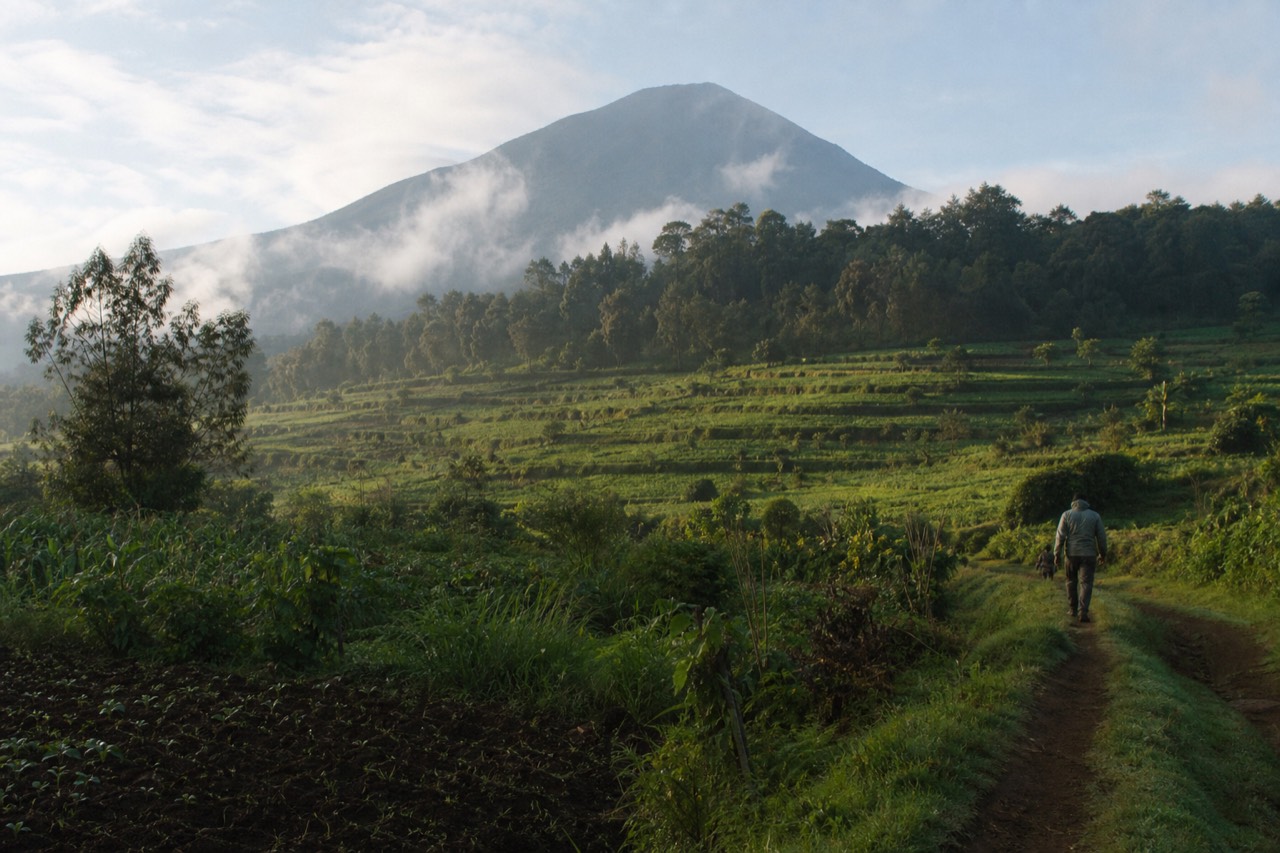
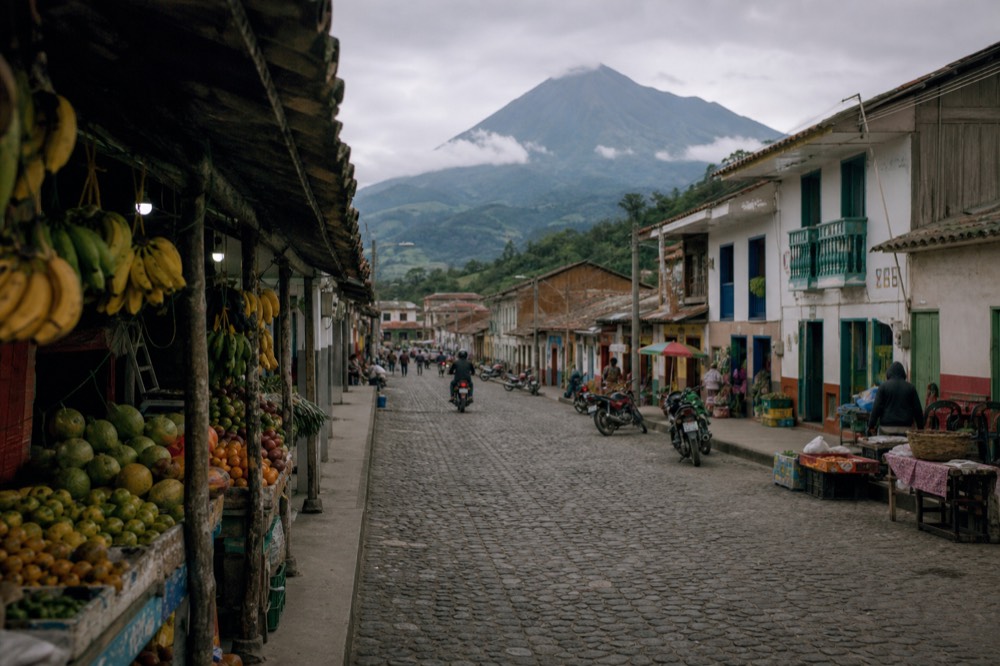
Cloud sits on the Virungas most mornings, and it moves. From the lawn at Kinigi you can watch a cone surface, hold for a minute, then disappear again behind wet grey. Below the treeline, potato and pyrethrum terraces run up to the park boundary in a hard green line you could trace with a finger. There is no buffer, no gradual thinning of farms into forest. Fields, then wall, then gorillas.
Volcanoes National Park is Rwanda's sector of the Virunga massif, the volcano chain shared with Uganda and the Democratic Republic of Congo. That massif holds roughly 604 of the world's estimated 1,063 mountain gorillas. The park is also the smallest, most heavily managed protected area you are ever likely to pay $1,500 to enter, and understanding why the number is that high starts with understanding how little of it there is.
Your Booking Choice
Choose a park activity first, then the Kigali day trip or overnight format around it.
A private gorilla day trek handles Kigali transport and meals, with the gorilla permit separate. Golden monkey and overnight options serve different plans.
Where is Volcanoes National Park, and what is it?
Volcanoes National Park sits in Musanze District in Rwanda's far northwest, about 90 minutes by road from Kigali. It is the Rwandan sector of the Virunga massif, a volcano chain shared with Uganda and the DRC, and it covers roughly 16,000 hectares of bamboo and montane forest running up the slopes of the volcanoes.
The practical geography is simple. Kigali is the arrival city and almost every trek departs from it. Musanze, still called Ruhengeri by plenty of people, is the market town at the foot of the mountains where lodges cluster. Kinigi, a few kilometres above Musanze, is where the park headquarters stands and where every activity in the park begins with a briefing.
The park is not remote in the way East African parks usually are. You do not fly to it, you do not spend a day on gravel, and you are never more than a short drive from a town with a supermarket. What makes it demanding is vertical, not horizontal. The forest starts where the farms stop, and it goes up immediately.
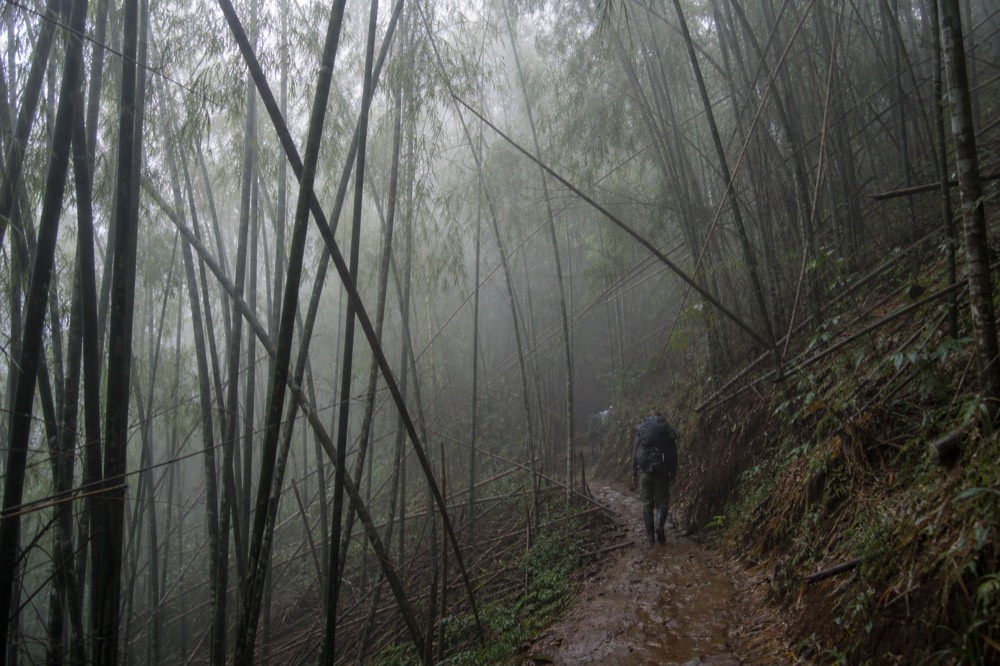
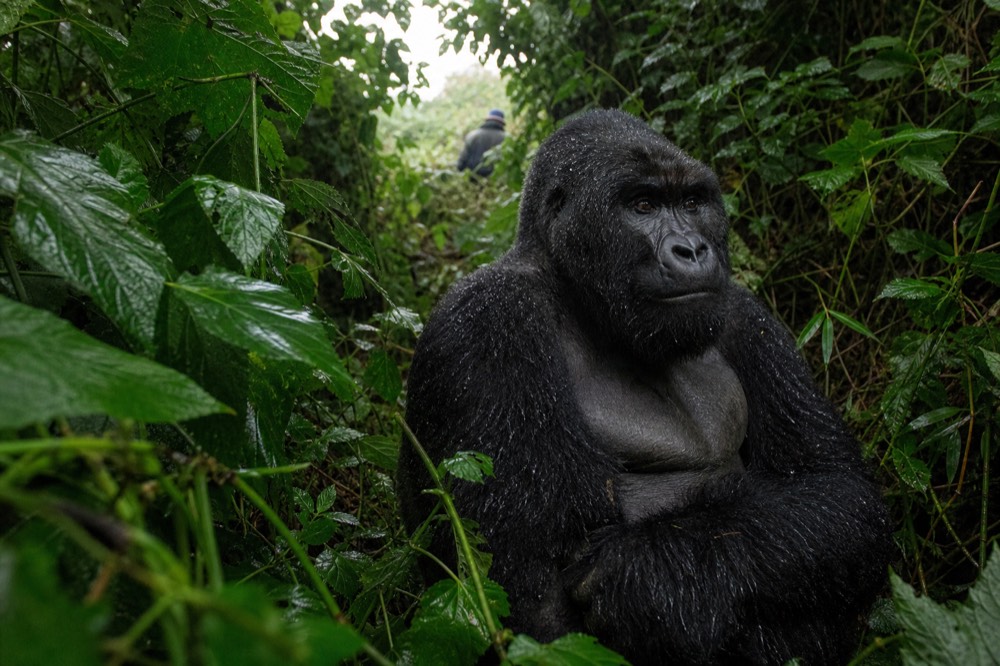
Golden monkeys live in the bamboo belt, and the gorilla families range through the thicker forest above and around it. The vegetation is the reason the trek is unpredictable: a family that fed low yesterday can be an hour further up today, and the trackers who went out at dawn are the only people who know.
How high is the park, and what does the altitude do to you?
Trekking in Volcanoes National Park happens between 2,500 and 4,000 metres. The Kinigi briefing point sits near the bottom of that band and the Dian Fossey memorial site sits at roughly 3,000 metres. Nobody arrives acclimatised. The thin air, the mud and the gradient together are what turn a short walk into a hard one.
Distance is a poor measure here. The Fossey memorial hike is about six kilometres round trip and takes four to six hours, which tells you everything about the surface underfoot. Volcanic soil holds water, the trails are churned, and above the bamboo the ground is a mat of vegetation that hides holes.
| Reference point | Altitude | What it means for you |
|---|---|---|
| Park trekking range | 2,500 to 4,000 m | The full band across all activities |
| Kinigi briefing and trailheads | around 2,500 m | Where every park morning starts |
| Dian Fossey memorial site | around 3,000 m | Roughly 400 to 500 m of climbing from the start |
| Fossey memorial hike | about 6 km round trip | 4 to 6 hours, moderate but muddy |
If you have a fitness question, our honest fitness guide to the gorilla trek breaks the climb down by family and by season. The short version: altitude bothers most people far less than the mud does.
What can you actually do inside the park?
Five activities are sold at Volcanoes National Park: mountain gorilla trekking at $1,500 for foreign non-residents, golden monkey trekking at $100, the Dian Fossey memorial hike listed at $75, and climbs on the volcanoes themselves, including Bisoke and Karisimbi. Cultural visits at the park edge are usually bought through an operator rather than the park.
The gorilla permit is the one that shapes every itinerary, because supply is fixed by biology rather than demand. Twelve habituated families, eight visitors each, one hour of viewing per group. That is 96 tickets a day and no mechanism for adding an eighty-first. The Rwanda Development Board booking portal sells them first-come, first-served, and the rate table is published in the open.
| Activity | Official permit, foreign non-resident | Rough shape of the day | Who it suits |
|---|---|---|---|
| Mountain gorilla trek | $1,500 | 2 to 8 hours in forest, 1 hour with the family | The reason almost everyone comes |
| Golden monkey trek | $100 | Shorter, in and around the bamboo belt | Second day, or the budget alternative |
| Dian Fossey memorial hike | listed at $75 | About 6 km, 4 to 6 hours | History over wildlife |
| Bisoke climb | set by the park authority | A full day on a summit trail | Hikers who want the volcano, not the primates |
| Karisimbi climb | set by the park authority | The long one, not a casual add-on | Experienced mountain walkers |
| Gorilla Guardians or village visit | bought through an operator | Half a day at the park edge | Rest day, or a rain contingency |
Two notes on that table. Volcano climbing rates change and are not always mirrored in third-party guides, so read them off the official portal before you build a budget around them. And the $75 attached to the Fossey memorial hike is a hike permit, not a discount gorilla permit: the two are entirely separate products.
That split is normal here, and our full breakdown of what a trek really costs shows how the two halves add up.
What happens at Kinigi at seven in the morning?
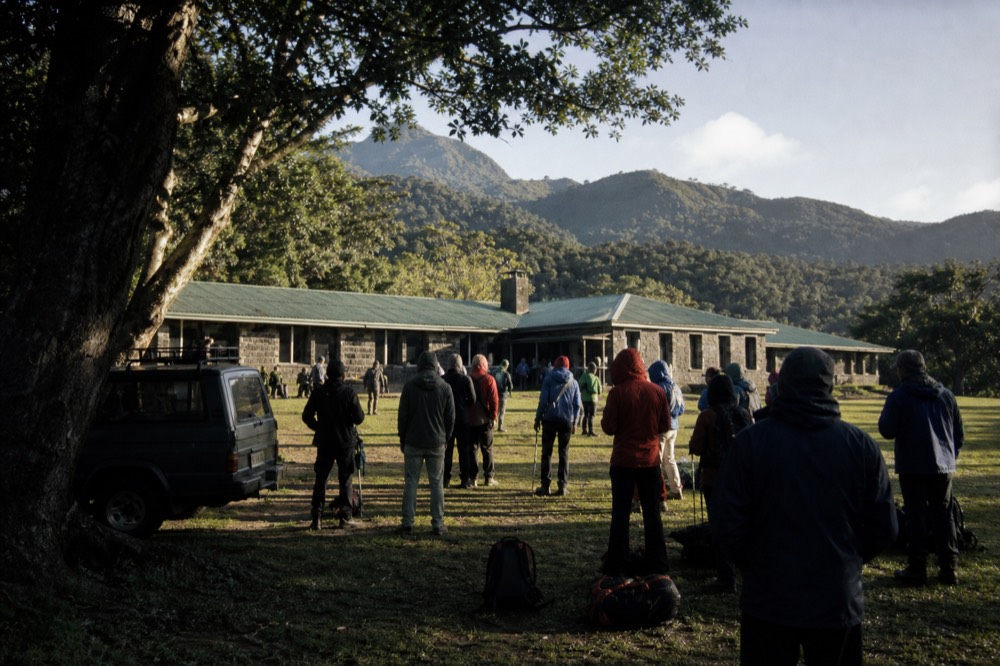
Everyone reports to the Rwanda Development Board offices at Kinigi park headquarters at 07:00. Rangers assign visitors to one of the twelve habituated families based on fitness and where the trackers have located each group. Briefing covers the rules, porters are hired, then vehicles drive to the trailhead for that family and walking starts.
The assignment matters more than people expect. Families range at different altitudes and distances, and the ranger deciding which group you join is doing so partly on what you say about your knees. Say the true thing. There is no prize for being put on the hardest allocation and then holding up seven other people.
| Time | What is happening |
|---|---|
| 04:30 to 05:30 | Pickup in Kigali for day-trip travellers |
| 07:00 | Reporting and briefing at Kinigi park HQ |
| 07:30 to 08:00 | Family assignment, porter hire, transfer to the trailhead |
| 08:00 onward | Walking, anything from under an hour to several hours |
| On contact | One hour with the family, 7 m distance, no flash |
| Afternoon | Descent, certificates, return to Musanze or Kigali |
The 07:00 line is why the day-trip pickups are so brutal. A 4:30am start from a Kigali hotel is not an operator flourish, it is arithmetic on a 90-minute drive plus the run up to Kinigi. Staying in Musanze the night before removes the whole problem, which is the strongest argument for the two and three-day packages.
How do you get to the park from Kigali?
Kigali to Musanze is roughly 90 minutes on good tarmac, then a further short drive up to Kinigi. There is no airstrip you would use and no public transport that connects to a 07:00 briefing. Almost everyone arrives by private vehicle, either their own hire or a driver-guide included in a tour price.
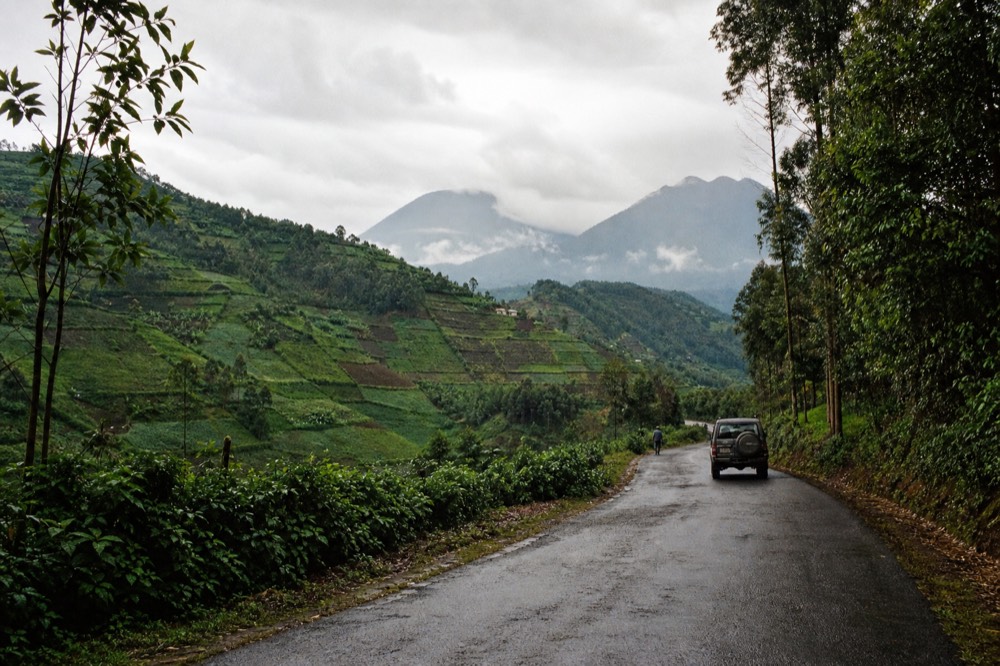
The road north is one of the better drives in East Africa, climbing through terraced hills the whole way. That is also why self-driving is less attractive than it looks: the last stretch to Kinigi and the trailhead transfers are rough, and a 4x4 with a driver who knows which track leads to which family saves an hour of guessing in the dark.
| Leg | Time | Notes |
|---|---|---|
| Kigali to Musanze | about 90 minutes | Sealed road, hilly, occasional fog on the ridges |
| Musanze to Kinigi park HQ | short local drive | Vehicles usually hired locally |
| Kinigi to your family trailhead | 15 to 60 minutes | Rough tracks, 4x4 territory |
| Trailhead to the gorillas | 30 minutes to 4 hours | Depends entirely on where the family fed |
Day-trippers do the whole thing twice in one calendar day, which is why the flagship 12-hour trip from Kigali reads as long as it does. Related reading: hour-by-hour account of that day.
What is the Dian Fossey memorial hike?
Dian Fossey's grave lies at the former Karisoke Research Center site inside the park, at roughly 3,000 metres, beside the grave of the silverback Digit and other gorillas. The guided memorial hike is about six kilometres round trip, four to six hours, with 400 to 500 metres of climbing, and carries its own permit listed at $75.
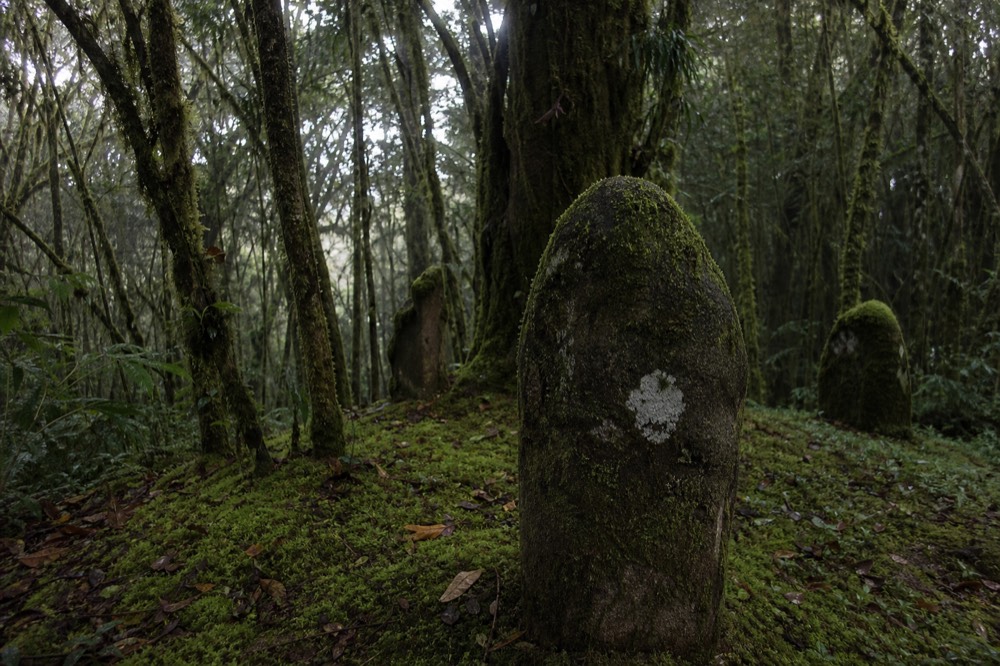
Fossey founded Karisoke on 24 September 1967, naming it for the two volcanoes it sat between, Karisimbi and Bisoke. Digit, a silverback from her study group, was killed by poachers on 31 December 1977 while defending his family. His death prompted the Digit Fund, which later became the Dian Fossey Gorilla Fund. Fossey was murdered in 1985 and the research she started carried on without her.
The Fund's work moved off the mountain in February 2022, into the Ellen DeGeneres Campus at Kinigi, the organisation's first permanent purpose-built home in Rwanda. The project cost around $15 million, with more than $13.4 million of that spent into the local economy during construction. It sits next to the park, and several day-trek operators offer it as an add-on. Our account of what happened to Dian Fossey covers the story the hike commemorates.
The optional Dian Fossey stop on that gorilla day is the Ellen DeGeneres Campus, not the grave at the former Karisoke site. Book a separate memorial-hike itinerary if the forest grave is your aim.
Is the park getting bigger?
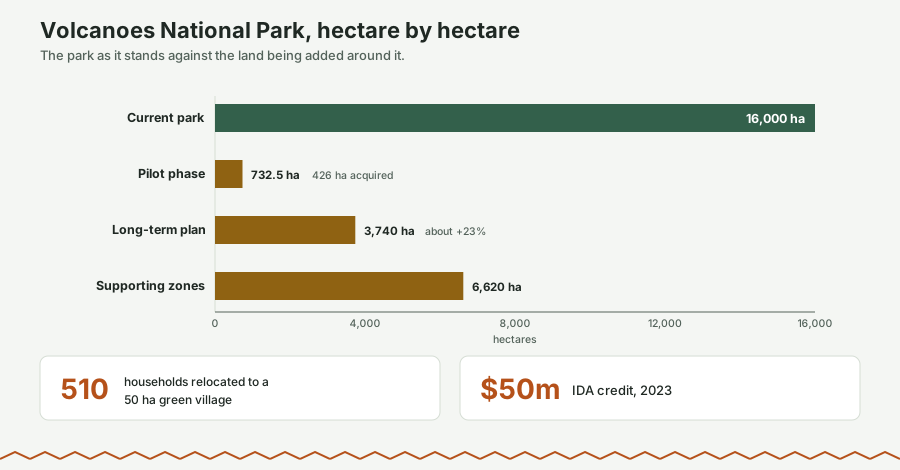
Yes. A pilot phase of the Volcanoes National Park expansion targets roughly 732.5 hectares, with about 426 hectares already acquired, and relocates 510 physically displaced households into a 50-hectare model green village around two kilometres from the site. The longer plan adds approximately 3,740 hectares, a rise of about 23 percent on the park's 16,000-hectare base.
This is the single biggest change to the park since habituation began, and almost no travel page mentions it. The pilot sits inside the Volcanoes Community Resilience Project, backed by a $50 million IDA credit under a financing agreement ratified in 2023, with livelihood restoration reaching roughly 992 affected households in total. Broader commitments across the project, including European Investment Bank participation, have been reported in the hundreds of millions.
| Element | Figure |
|---|---|
| Current park base | about 16,000 hectares |
| Pilot-phase target | 732.5 hectares, about 426 already acquired |
| Long-term expansion plan | about 3,740 hectares, roughly a 23 percent increase |
| Supporting zones planned | about 6,620 hectares |
| Households physically relocated, pilot | 510, into a 50-hectare green village |
| Households receiving livelihood support | about 992 |
| Anchor financing | $50 million IDA credit, 2023 agreement |
A $3.4 million horticulture hub was inaugurated at Kinigi as part of the same push, positioned as the gateway to the wider expansion. Whichever side of the ledger you weigh, the honest framing is that the park is growing at a direct human cost, and the resettlement programme is the state's answer to that cost. The ethics of visiting at all is a fair question to hold alongside it.
What is Kwita Izina, and can visitors attend?
Kwita Izina is Rwanda's annual gorilla naming ceremony, held at Kinigi in the foothills of the park. The 20th edition took place on 5 September 2025 with 40 baby gorillas named. The announced date for the 21st edition was 4 September 2026 in Kinigi, Musanze District, with 22 infants on the list to be named.
The ceremony sits inside the same national campaign that put Visit Rwanda on Arsenal and Clippers jerseys: conservation as the country's public face.
The ceremony borrows from the Rwandan tradition of naming a newborn in front of the community, and it functions as the country's conservation showpiece. Names are given by invited namers, and the roll of infants is the closest thing the park has to an annual birth announcement.
| Edition | Date | Place | Infants named |
|---|---|---|---|
| 20th, Kwita Izina 2025 | 5 September 2025 | Kinigi | 40 |
| 21st, Kwita Izina 2026 | 4 September 2026 | Kinigi, Musanze District | 22 announced |
If your dates are flexible and you want the park at its noisiest, early September is it. If you want the park quiet, that is the week to avoid. Either way the trekking schedule keeps running, and the month-by-month picture matters more to your trek than the ceremony does.
What lives here besides the gorillas?
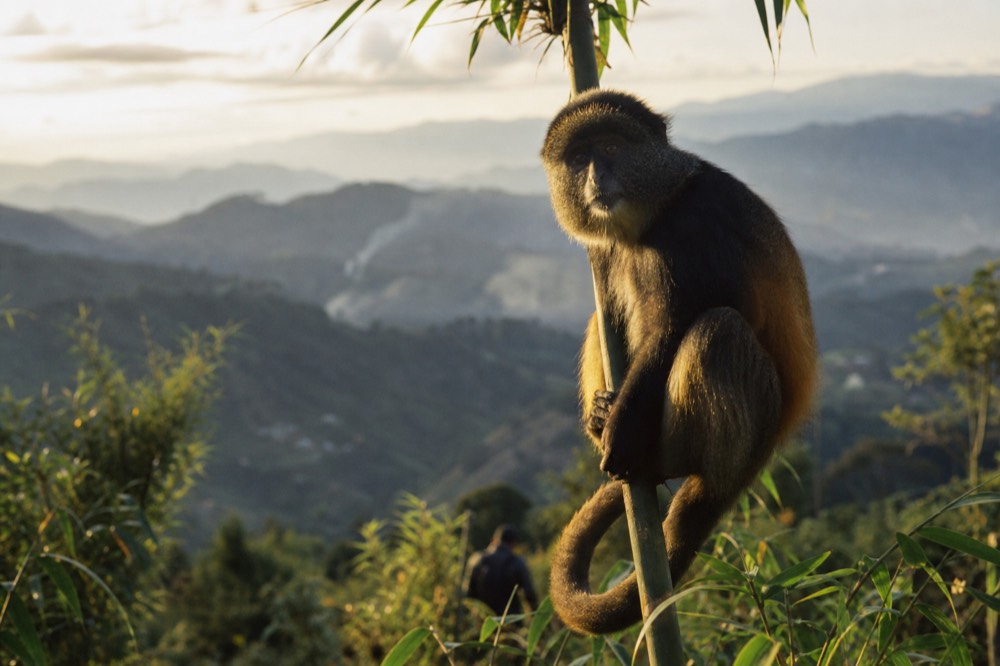
Volcanoes National Park holds an estimated 4,626 golden monkeys, an endangered Virunga endemic, and 127 recorded bird species including Albertine Rift endemics such as Shelley's Crimsonwing and Grauer's Swamp-warbler. The gorillas dominate the marketing, but the bamboo belt and the wetland pockets carry the species you cannot see anywhere else.
The golden monkey figure comes from the 2017 to 2018 survey, with a confidence interval of 4,165 to 5,088, and it sits alongside 4,331 in 2007 and 4,487 in 2011. The subpopulation is described as stable, which for a species classed as Endangered is a better result than it sounds. The gorilla side of the same conservation ledger is counted in how many mountain gorillas are left.
Birders come for the Albertine Rift list rather than the headline species. The park's 127 recorded species include threatened birds tied to specific habitats inside the boundary, particularly waterbodies and mixed forest, which is one reason the expansion plan matters beyond gorillas.
Golden monkey permits are a fifteenth of the gorilla price, and the private golden monkey tour lists entrance fees among its inclusions. Our golden monkey trekking guide works through when that trade is worth making.
Where does Musanze fit into the trip?
Musanze is the town below the park and the practical base for anyone not day-tripping from Kigali. It is where the lodges, the restaurants and the last ATM are. Staying there converts a 4:30am departure into a civilised one and puts you inside easy reach of the 07:00 Kinigi briefing.
The town also anchors the local economy that the park sits inside. Terraces climb to the boundary because land here is worth farming, and the tension between that and a growing protected area is not abstract. Rwanda channels 10 percent of national park tourism revenue, gorilla permits included, into a revenue sharing programme for communities next to the parks, a share raised from 5 percent in 2017 when the permit price went to $1,500. The official tourism board page carries the policy.
For most travellers the choice is binary: one long day from Kigali, or two nights in Musanze with a slower trek and space for a second activity. Compare every bookable trek side by side before you decide, because the two shapes of trip are priced very differently once the permit is in the sum.
What does a day at the park actually cost?
A gorilla day costs the $1,500 permit plus transport and guiding. Day trips from Kigali start around $260 to $360 with the permit excluded, so the realistic floor is roughly $1,760. All-in products that include the permit start at $3,350 for one day and $3,746 for three days, both non-refundable.
The permit is the constant. Everything else is a decision about comfort, time and how much arranging you want to do yourself.
| Line item | Typical figure | Permit included? |
|---|---|---|
| RDB gorilla permit, foreign non-resident | $1,500 | This is the permit |
| Day trip from Kigali, lowest ground cost | from $260 | No |
| Day trip from Kigali, most-reviewed option | from $360 | No |
| Trek plus Dian Fossey or Guardians add-on | from $300 | No |
| One-day all-in, everything arranged | from $3,350 | Yes |
| Three-day safari with lodges and meals | from $3,746 | Yes |
| Golden monkey permit | $100 | Separate product |
The gap between $1,760 assembled yourself and $3,350 handed over whole is the price of not doing the paperwork, and for some travellers that is money well spent. Our permit guide walks through the booking portal step by step if you would rather keep the difference.
Is it safe to travel to Musanze District right now?
The US advisory issued 4 June 2026 rates Rwanda Level 3 for crime, unrest and health risks. It explicitly excludes Volcanoes National Park from the Level 4 DRC border area. Review current advice and insurance for the whole itinerary before booking.
Both halves of that need saying plainly. The park is in a named district, and the strictest part of the advisory is drawn as a border band rather than a district-wide warning. The UK Foreign Office takes a narrower position, advising against all but essential travel only to parts of Rusizi District. Read the current US advisory yourself rather than any operator's summary of it, including ours, and check whether your travel insurance responds to a Level 3 destination.
Our full read on Rwanda safety goes through Kigali, the road north and the border question in more detail, without softening any of it.
Frequently asked questions
How many gorilla permits are sold each day in Rwanda?
Eighty. Twelve gorilla families are fully habituated for public visits and each takes a maximum of eight visitors per day, for one hour. Permits cost $1,500 per person for foreign non-residents and sell first-come, first-served through the Rwanda Development Board portal. There is no waitlist mechanism that adds capacity on a busy day.
How far is Volcanoes National Park from Kigali?
Kigali to Musanze is about 90 minutes by road, then a short further drive up to Kinigi where the park headquarters sits. Because briefing is at 07:00 sharp, day trips from Kigali collect travellers between 4:30am and 5:30am. Staying in Musanze the night before removes the pre-dawn start entirely.
Can you visit Volcanoes National Park without trekking gorillas?
Yes. Golden monkey trekking costs $100 for foreign non-residents, the Dian Fossey memorial hike is listed at $75, and the park sells climbs on Bisoke and Karisimbi. All of them brief at Kinigi at 07:00. Only the gorilla trek carries the $1,500 permit and the 96-per-day cap.
What is the minimum age for gorilla trekking in Rwanda?
Fifteen years, with no exceptions. The Rwanda Development Board states it on the official booking page: tracking can be done by persons aged 15 and above. Families travelling with younger children usually split the day, with one adult trekking while the rest of the group takes a park-edge activity or stays in Musanze.
When is Kwita Izina 2026?
The announced date for the 21st Kwita Izina gorilla naming ceremony was 4 September 2026 at Kinigi in Musanze District, with 22 baby mountain gorillas announced for naming. The 20th edition ran on 5 September 2025 at the same site and named 40 infants. Trekking continues as normal around the ceremony week.
How high do you climb on a gorilla trek?
Trekking areas run between 2,500 and 4,000 metres, with trailheads near the lower end of that band. The walk to a gorilla family can take anywhere from half an hour to four hours depending on where the trackers found them that morning. Rangers assign families partly on stated fitness, so answer honestly at the briefing.
Choose The Experience That Fits Your Trip
General starting point; dates, pickup and passenger acceptance still need confirmation.
Choose your Volcanoes activity · alternatives & optional controls
- Golden Monkey Trek From Kigali — 13 to 15 hours. Private 4x4, entrance fees and a personal porter for the golden monkey itinerary. Golden-monkey itinerary admission and entrance fees included. English listed. Ages 12+, up to 75. All Kigali hotels; itinerary returns Kigali.
- Three-Day Rwanda Gorilla Safari — 3 days. Lodge accommodation, meals, 4x4 transport and one gorilla permit per person. One gorilla tracking permit per person included. English listed. Ages 15+, up to 80. Kigali airport or hotel by arrangement; returns Kigali airport. Minimum two adults; lodge option must be confirmed.
- Dian Fossey Tomb Hike From Kigali — 13 to 15 hours. Private 4x4 transfer, hiking permit, porter and lunch for the tomb hike. Dian Fossey hike permit included; no gorilla trek. English listed. Ages 15+, up to 75. All Kigali hotels; round trip confirmed public product page. Strong fitness required. This is not a gorilla trek.
Private Gorilla Trek From Kigali
Before arranging your park stay, check the date and permit details of the activity you actually want.
12 hours. Private transport, driver-guide and meals around the park trek. Gorilla permit purchased separately; operator offers assistance. English listed. Ages 15+, up to 85. Pickup and drop-off anywhere in Kigali.
Check dates & final price on Viator